Exploration
Hands-on intro bootcamp
Best for: Curious beginners who want to try robotics hands-on.
Includes all hardware, a certificate, and a digital project folder.
View details for Level 1: ExplorationHands-on robotics and AI in teams of four. Students learn the physics, electronics, and code behind every part, then use that understanding to solve real challenges.
Reserving is free. Not ready yet? Ask Dr. Wang a question

New? Level 1. Experienced? Level 2.
Hands-on intro bootcamp
Best for: Curious beginners who want to try robotics hands-on.
Includes all hardware, a certificate, and a digital project folder.
View details for Level 1: ExplorationTeam build, in groups of four
Best for: Students who learn by doing and build with a team.
Includes all hardware, a certificate, and a digital project folder.
View details for Level 2: AcceleratorA real engineering quest
Best for: Students ready for a portfolio-worthy challenge.
Includes all hardware, a final showcase for tech leaders, and a digital portfolio.
View details for Level 3: AdventureFounding cohort prices. Reserve a spot by November 10, 2026, to lock in your price. Prices for future cohorts may change as hardware costs change.
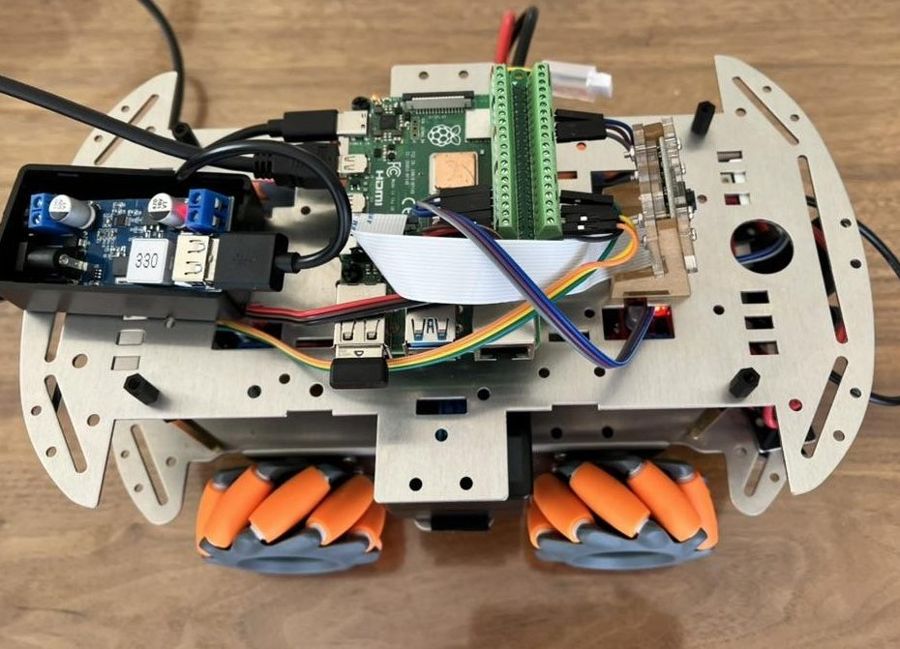
In Level 2, your team builds this robot from real parts, then writes the Python code that lets it steer itself around a course.

Easy to ask. But you have to understand the robot to answer them.
What makes a motor spin?
Physics + electronicsHow do you slow it down, or reverse it?
Electronics + controlsWhy does a faster robot get less stable on a turn?
Physics + designWant the answers? Level 1 is where you find out.
School teams focus on building and competing. We focus on understanding.
| Typical school team | The New Infinity |
|---|---|
| Large teams; a few students do most of the work | Teams of four, every student has a role |
| Assemble pre-made parts | Learn why each part works |
| Trial and error until it works | Design, test, and refine with measurements |
| A great complement to a school team, not a replacement for it. | |
Every session starts with one question. For example, how would you know a battery is healthy? The meter can look fine until the battery has real work to do. Knowing what to measure, and why, is what engineers do.
From Level 2, students use AI to help write and fix code. But AI can’t hold the probes, or look at a robot and see why it keeps drifting left.
Only 8 students per level, in two teams of four. Reserving is free, and nothing is paid until you enroll. Level 2 dates are set with each team, and Level 3 starts in early 2027.
Sessions meet in Dr. Wang’s home robotics lab in Saratoga, near Saratoga High School. We share the exact address with families once they confirm and pay. Parents are welcome to stay for the first session.
With 20+ years in AI and robotics, Dr. Wang is a former Purdue professor and former engineering leader at Apple and Adobe, with executive education from Stanford GSB. She designs every program and leads every session.
“After years of researching and building AI, I want students to do more than use it: to understand it, question it, and build with it.”